
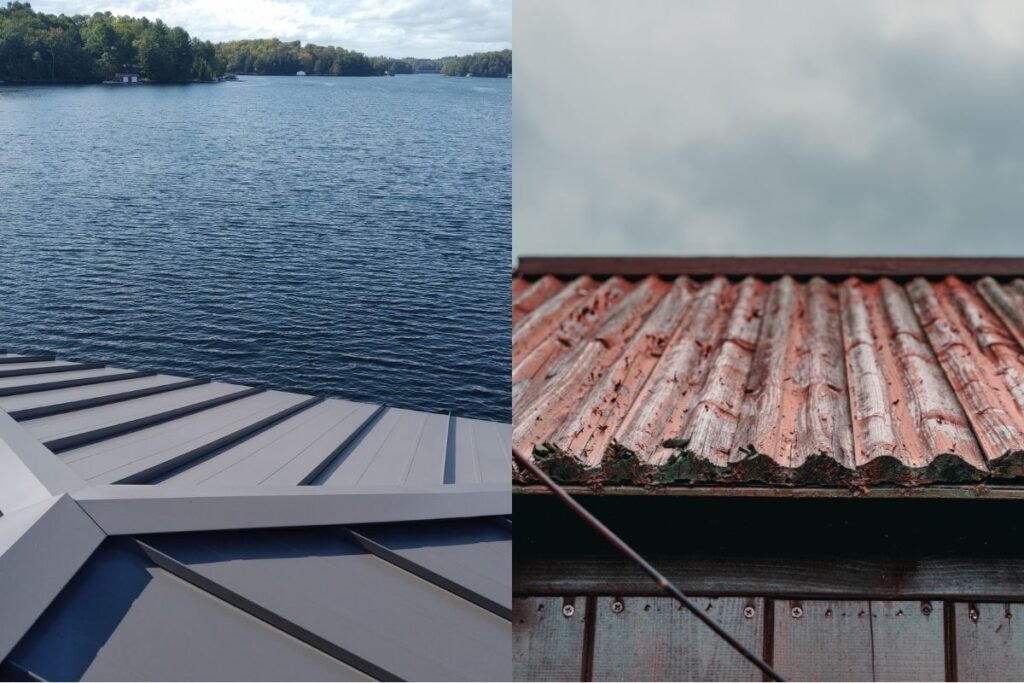
Most people shopping for a metal roof eventually land on the same two names: standing seam and corrugated. Both fall under the same broad category of metal roofing, and both have a long track record, but they’re built differently, priced differently, and suited to fairly different kinds of projects.
This guide breaks down how the two systems compare, where each one tends to make the most sense, and what to weigh up before settling on one.
What Each System Actually Is
The two styles look different at a glance, but the real distinction comes down to how the panels are fastened and how they handle water.
Standing Seam Roofing
Standing seam panels run vertically up the roof, joined together at raised seams where the fasteners sit hidden underneath. Nothing penetrates the visible surface of the panel, which is the defining feature of the system and the source of most of its advantages.
Corrugated Roofing
Corrugated panels use a wave-like profile, with rounded ridges and valleys running across the sheet. They’re fixed in place with screws driven directly through the raised portions of the panel into the structure below, leaving exposed fasteners across the roof surface.
Installation and Fastening Differences
This is where the two systems diverge most sharply, and it’s the root of nearly every other difference between them. Standing seam relies on concealed clips and seams that lock or crimp together, which takes more time, more specialized tools, and a contractor familiar with the system. Corrugated panels go up faster, since screwing through the panel face into the substrate is a more straightforward process that most general roofing crews can handle without specialized training.
That speed comes at a cost down the line. Exposed fasteners on a corrugated roof sit directly in the path of sun, rain, and temperature swings, which means the rubber washers under each screw eventually harden, crack, and need replacing. Standing seam avoids this entirely, since there’s no exposed hardware for the weather to work on.
Cost Comparison
Corrugated panels are consistently the more affordable option, both in material cost and labor. The simpler installation process means fewer billable hours, and the panels themselves are cheaper to manufacture without the precision seaming that standing seam requires.
Standing seam typically costs noticeably more per square foot, sometimes a significant amount more depending on the gauge and finish chosen. For budget-driven projects like agricultural buildings, sheds, or temporary structures, that price difference often settles the decision on its own.
Durability and Expected Lifespan
Both systems are considerably more durable than asphalt shingles, but they aren’t equal to each other. A well-installed standing seam roof commonly lasts 40 to 60 years with minimal intervention, largely thanks to the absence of exposed fasteners that would otherwise need periodic attention.
Corrugated roofing typically lasts 20 to 30 years before the fastener washers and general wear start to call for more involved maintenance or replacement. That’s still a strong lifespan compared to most non-metal roofing options, just shorter than what standing seam offers.
Weather and Water Performance
Standing seam’s raised, interlocking seams shed water more effectively than corrugated panels, which makes it the stronger choice for low-slope roofs or regions with heavy rain and snow. Corrugated roofing performs perfectly well on steeper slopes where gravity does more of the work, but it’s generally not recommended below a certain pitch, since water has more opportunity to find its way under the panel edges or around exposed fasteners.
Appearance and Architectural Fit
Standing seam has a cleaner, more modern look, with unbroken vertical lines and no visible hardware. It shows up often on contemporary homes and commercial buildings where the roof itself is part of the architectural statement.
Corrugated roofing carries a more traditional, utilitarian look, closely associated with barns, sheds, and industrial buildings. That said, it’s seen a resurgence in modern farmhouse and rustic-style homes, where the visible texture and exposed fasteners read as intentional rather than purely functional.
Trim, Flashing, and Fastener Considerations
Whichever system gets chosen, the roof rarely works as a standalone element. Ridge caps, flashing, and trim need to match the panel profile precisely to keep every joint and transition watertight, and the fastener specifications differ between the two systems since standing seam clips and corrugated screws aren’t interchangeable.
Sourcing the right trim alongside the panels makes this part of the project considerably easier to get right. PBS Direct’s metal roofing and wall trim collection covers the flashing and edge components for both standing seam and corrugated systems, which is useful when a project needs matching trim across different panel types or transitions between roof and wall.
Which System Fits the Project
For homes and commercial buildings meant to last for decades, where appearance and low maintenance carry real weight, standing seam usually justifies its higher cost over time. It’s also the stronger choice for low-slope roofs or climates with serious rain and snow.
For agricultural buildings, sheds, garages, and budget-conscious projects where speed and upfront cost matter more than refinement, corrugated roofing remains a dependable, well-proven option that’s stood the test of time for good reason.
Conclusion
Standing seam and corrugated metal roofing both deliver real durability, but they get there through different means and at different price points. Standing seam trades a higher upfront cost for decades of low maintenance and superior water resistance, while corrugated roofing offers a faster, more affordable install with a shorter but still solid lifespan. The right choice usually comes down to the building itself, the climate, and how long the roof needs to perform before anyone has to think about it again.